Older architectural footprints across Allegheny County create unique harborages for Blattella germanica. In the dense rowhouses of Lawrenceville, Bloomfield, and the South Side Flats, shared party walls allow insect…
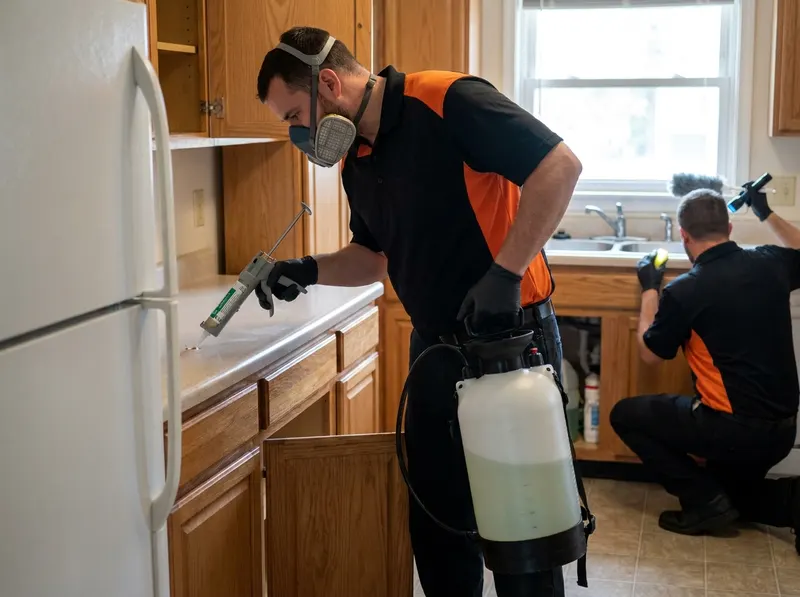
Older architectural footprints across Allegheny County create unique harborages for Blattella germanica. In the dense rowhouses of Lawrenceville, Bloomfield, and the South Side Flats, shared party walls allow insect colonies to travel freely through shared joist pockets and plumbing chases. German cockroaches rely heavily on food biofilms and grease residues behind heat-generating kitchen equipment. Nexford Pest Solutions deploys HEPA-filtered extraction vacuums directly to motor housings, under-counter corners, and hinge recesses to physically remove nymph clusters, adults, and allergen-dense cast skins. Technicians strip volatile organic residues using specialized cleaners before placing baits, adhering strictly to EPA Integrated Pest Management standards to prevent bait rejection.
Bait matrix chemistry relies on physiological transfer rather than contact repellents. A synthetic gel matrix combined with active agents like indoxacarb or dinotefuran exploits secondary ingestion: foraging cockroaches consume the bait, return to voids inside century-old plaster or lath assemblies, and transfer the active ingredient to sheltered nymphs via coprophagy and necrophagy. This treatment avoids broad-spectrum aerosol sprays, which drive gravid females deeper into baseboard recesses and subfloors. Guidelines set by the CDC environmental sanitation protocols and structural principles published by the Penn State Extension entomology program verify that bait performance increases dramatically once competing food sources are sanitized.
Moisture control remains critical in elevated topography like Mount Washington and Brookline, as well as shaded valleys near Frick Park and Highland Park. Rubble stone foundations, common throughout Squirrel Hill, Shadyside, and East Liberty, often retain elevated relative humidity, creating ideal nesting grounds for Oriental cockroaches alongside residential drain stacks. Technicians map these points of ingress, pairing the bait matrix with juvenile hormone mimics known as insect growth regulators (IGRs). As documented by the Pest Control Technology technical index and publications from the Entomological Society of America certification board, IGRs disrupt chitin synthesis, rendering surviving roaches permanently sterile and arresting population resurgence.
Preventing secondary migrations in commercial and mixed-use corridors like the Strip District requires precise placement protocols. Rather than continuous bead lines, micro-dots measuring roughly 0.25 to 0.5 grams are introduced every 12 to 18 inches inside hidden cabinet mortises, utility access points, and mechanical service wells. This placement adheres to food safety metrics outlined by NSF International standards and environmental compliance directives from the Pennsylvania Department of Environmental Protection. Residents can confirm service arrangements, inspect targeted void locations, or text interior photos to Nexford Pest Solutions at (215) 217-0928 to initiate structural stabilization without disruptive multi-year contracts.
Every job gets a firm, written price after a free on-site visit.
Tell us about your cockroach sanitation and bait matrix application job in Pittsburgh and we'll send a clear, written quote, usually the same day.
 Nexford Pest Solutions